
BFT Gate Repair in Surprise: A Homeowner’s Guide
BFT operators don’t fail the way LiftMaster or Elite operators do, and a technician who treats them like an American brand will quote you a motor replacement when the real problem is a parameter buried in the encoder menu. That’s the single most expensive mistake we see on BFT systems around Surprise. This guide translates BFT’s diagnostic logic into plain English so you can tell the difference between a genuine breakdown and a reset. If you’d rather not climb that diagnostic ladder yourself, call (877) 657-0401 and we’ll take it from there.
Why BFT Gates Behave Differently Than American Brands
BFT is Italian engineering, and it shows in the way the board thinks. American operators tend to fail loudly: a dead motor, a blown fuse, a limit switch that stops making contact. BFT boards are smarter and quieter about it. They monitor current draw, encoder position and travel time continuously, and when something drifts out of range they don’t die – they refuse to move on purpose. That distinction matters enormously when you’re standing in your driveway in Surprise trying to figure out why the gate stopped halfway.
Three habits of BFT systems catch people out:
- Parameter-driven behavior. The board stores settings for travel time, slowdown points, obstacle sensitivity and motor force. A power surge or a manual release can scramble those values, and the gate then “fails” perfectly correctly according to bad parameters.
- Encoder-based positioning. Instead of physical limit switches, many BFT arms and sliding operators track position through an encoder. If the encoder reading drifts, the gate loses its reference point and stops short or reverses.
- Deliberate fault lockout. After a set number of failed cycles the board locks out to protect the motor. It looks dead. It isn’t.
That last one is where the unnecessary motor replacements come from. In our experience, a large share of BFT systems that get condemned as “motor’s gone” are simply locked out or mis-parameterized. We work on whatever gate you have, and BFT is one of nine brands our technicians handle, alongside FAAC, LiftMaster, Mighty Mule and the rest. Our technicians have up to 13 years of experience, and the BFT quirks still teach us something.
The Three BFT Failure Modes Heat Exposes in Surprise
Surprise summers are hard on gate automation, and BFT systems fail in three fairly predictable ways once the heat settles in. Knowing which one you’re dealing with tells you whether you’re looking at a reset or a repair.
1. Thermal cutout trips
Every motor has a duty cycle – a limit on how many cycles it can run in a given time before it needs to cool. BFT boards enforce this strictly. In sustained heat, a gate that cycles more than usual (kids, deliveries, a dog that has opinions) can hit the thermal threshold and shut down. The symptom is a gate that works fine in the morning and quits by mid-afternoon, then works again the next morning. The fix isn’t a new motor. It’s usually airflow, shade, mounting position and adjusting how hard the operator works. If the trip happens repeatedly, the motor or control board may be drawing more current than it should, and that’s worth a proper electrical diagnosis.
2. Encoder drift on articulated arm models
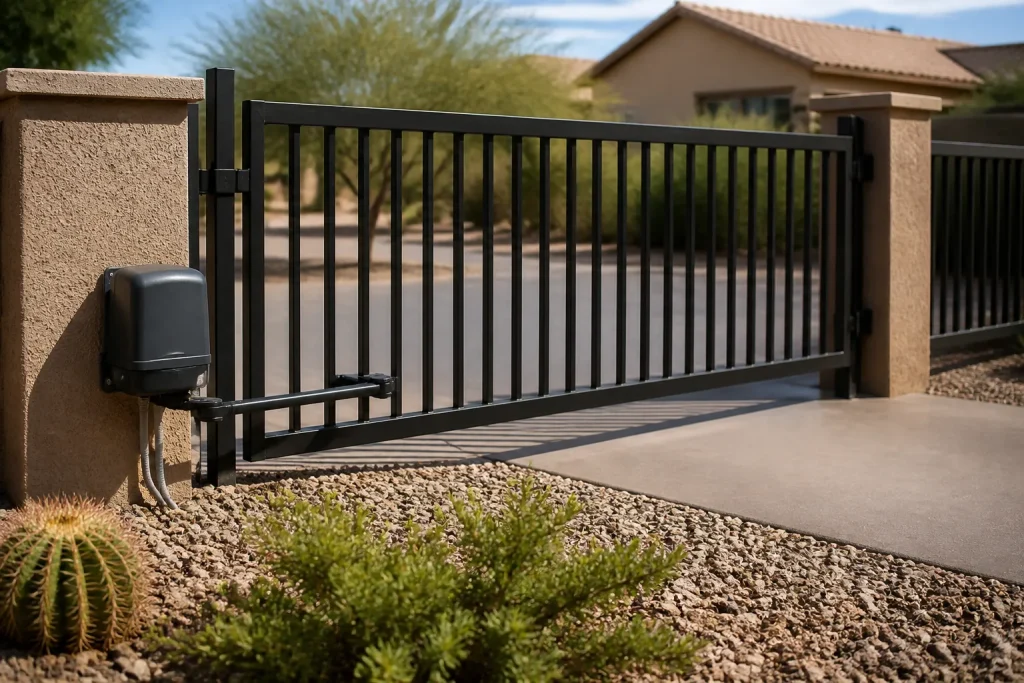
Articulated arm operators swing the gate through an arc, and the board relies on the encoder to know exactly where the arm is at every point. Heat expansion in the arm, worn pivot bushings or a slightly sagging gate hinge all change the geometry, and the encoder reading no longer matches reality. The gate stops short, reverses at the wrong point, or refuses to close. Resetting the travel limits often restores it, but if drift keeps returning, there’s a mechanical cause underneath that needs fixing first.
3. Undervoltage from a tired supply
When the incoming voltage sags, BFT boards log a fault and stop rather than strain the motor. Long low-voltage runs and aging transformers are the usual suspects. This one is genuinely an electric gate repair job, not a homeowner fix, because you’re working with mains power and low-voltage control wiring together.
Safety note: the control board, transformer and any mains wiring carry live voltage. Don’t open the enclosure to chase a fault. BFT diagnostics are safe to read from the outside; the wiring inside is a job for a trained technician.
How to Read BFT LED Blink Codes on QUBO and DEIMOS Boards
The QUBO and DEIMOS control boards are the two units we encounter most often in residential installs around Surprise, and both speak through a single LED on the board. The Italian manual is not much help at 7pm on a Sunday, so here’s the working translation.
The LED reports a fault as a repeating pattern: a number of quick blinks, a pause, then the pattern repeats. Count the blinks in one burst and you have the fault number. The pattern is consistent, so watch two or three cycles to be sure you counted right.
- One blink: usually a command or input issue – a stuck button, a jammed keypad contact, a safety edge that isn’t reporting clean.
- Two blinks: a photocell or safety device problem. Check for a leaf, spider nest or sun glare hitting the beams before anything else.
- Three blinks: encoder or limit reference lost. The board no longer knows where the gate is.
- Four or more blinks: typically motor current, overload or board-level faults.
Treat those as a starting point, not gospel. Different BFT models assign fault numbers differently, and the blink count only narrows the field. What it does well is tell you whether you’re chasing a safety device, a positioning issue or a power problem – which is exactly the fork in the road. If the count points at the motor or the board itself, that’s when to bring in a technician who can read the parameters directly rather than guess.
Why BFT Remotes Lose Pairing in Extreme Heat
A remote that stops working in July is a common call in Surprise, and the cause is usually not what people expect. Two very different failures produce the same symptom, and the fix depends on which one you have.
Transmitter side. Heat stresses the remote itself: the battery’s output drops, the solder joints on the circuit board can crack, and the buttons lose their spring. A remote that works when you press hard, or works from two feet away but not from the car, is a transmitter problem. Try a fresh battery first. If that doesn’t do it, the remote is the issue.
Receiver side. If several remotes stopped working at once, the problem is in the receiver or the board’s memory. BFT receivers can lose stored codes after a power event or a board fault, and re-pairing is the fix – not replacing every remote. This is where homeowners get sold a set of new transmitters they didn’t need.
To tell them apart, test a second remote. One remote failing points at the transmitter. All of them failing points at the receiver or board. Either way, pairing and re-pairing a BFT system is a menu operation, not a mechanical repair, and it’s one of the diagnostics we run before recommending any parts.
BFT Parts in Arizona: What’s Local and What Has to Ship
Here’s the part most guides skip. BFT is a strong brand with a thinner parts pipeline in Arizona than the big American names, and that reality shapes repair timelines. Some components are available locally through gate and access-control suppliers; others come from a regional distributor with stock further east. When a board, motor or receiver has to ship, the repair stretches from a single visit into a two-stage job.
What this means in practice:
- Diagnose completely before ordering. Guessing at parts on a BFT system is expensive and slow. A full diagnostic on the first visit is what keeps the second visit short.
- Resets and re-pairing happen on the spot. Encoder resets, travel limits and remote pairing don’t need a part. If your gate is only locked out or mis-parameterized, you’re done in one visit.
- Mechanical parts are usually easier. Hinges, rollers, bushings and safety edges are interchangeable enough that a good specialist can source them quickly.
- Board and motor swaps need lead time. Plan on a gap between diagnosis and repair when the fault is electrical and the part isn’t local.
This is exactly why brand range matters. A company that only handles one brand will tell you your BFT system needs replacing to sell you what they stock. Because we work on BFT alongside LiftMaster, FAAC, Mighty Mule and others, we diagnose the actual fault and then tell you honestly what the part situation looks like.
Repair or Replace? The BFT Board Math
The question most Surprise homeowners eventually ask is whether a failing BFT operator is worth fixing. The honest answer depends on what’s failed and what the rest of the system looks like.
Lean toward repair when:
- The fault is a reset, a parameter issue, a safety device or a remote pairing problem.
- The motor and gearbox are mechanically sound and the gate swings freely by hand with the operator disengaged.
- The board is intact and the failure is in a sensor, receiver or wiring.
- The gate and posts are in good shape, so a new operator means paying for mechanical work you don’t need.
Lean toward replacement when:
- The control board is dead and the replacement board is a large share of a whole new operator’s cost.
- The motor is drawing excessive current, the gearbox is worn, or the unit has had repeated electrical faults.
- Parts for that model are no longer available and lead times are open-ended.
- A comparable BFT unit, FAAC or LiftMaster operator would fit the existing gate and give you a cleaner path forward.
There’s no universal number that settles it. What settles it is a real diagnostic plus a written price for both paths, so you can compare like for like instead of guessing. If you want a second opinion before committing to a motor swap, our electric gate repair team handles the diagnostics and the replacement conversation in one visit.
When to Call a Pro
Some things are worth checking yourself: a blown battery in the remote, a leaf blocking a photocell, a manual release lever left disengaged, debris on the track. Beyond that, the work moves inside the control enclosure and the mains supply, and that’s where a specialist belongs. Call us when your gate:
- Stops and reverses without an obvious obstruction
- Runs inconsistently through the heat of the day
- Loses remote pairing repeatedly after a power bump
- Shows a consistent LED blink pattern you can’t clear
- Will not move at all and the manual release doesn’t help
We cover the full lifecycle – repair, automated diagnostics and new installation – so a single call covers diagnosis and the fix. For the slower-moving work, our gate repair service handles the mechanical side, and when a system reaches end of life our installation team measures the opening and gives you a written price before anything is ordered. If you’re weighing a new operator rather than a repair, we also work closely with the wider Surprise community of property managers on multi-unit and HOA gate systems, where getting the right diagnosis first saves everyone money. For a deeper look at our full range, start at Gate Repair Surprise.
The Bottom Line
BFT makes a genuinely capable operator, and most of what we see fail in Surprise isn’t the motor at all – it’s a thermal cutout, an encoder that’s lost its reference, a receiver that needs re-pairing, or a parameter that got scrambled. The watch-out is a technician who diagnoses by brand habit rather than by what the board is actually telling them. Read the blink code, know the three heat-related failure modes, and be suspicious of any motor replacement quote that arrives without a parameter check first. If you need hands-on help, call (877) 657-0401. We answer 24/7, fast dispatch runs from 7am to 7pm Sunday through Friday, and the price is quoted and agreed before any work starts.
Frequently Asked Questions
It’s almost always a thermal cutout or a voltage sag, not a dead motor. BFT boards enforce a duty cycle and will lock out a motor that’s running hot or drawing current above its threshold, then restore it once things cool. If the pattern repeats daily, the operator needs a proper current and supply check rather than a replacement. Call (877) 657-0401 for an exact quote – estimates are free.
Test a second remote. If one remote fails, it’s the transmitter; if all of them fail together, it’s the receiver or the board’s memory. Re-pairing fixes receiver-side failures, and a new battery fixes most transmitter-side ones. If re-pairing won’t hold, the board needs a proper look, and we answer 24/7 at (877) 657-0401.
Encoder and travel-limit resets are menu operations that don’t expose you to mains voltage, so many homeowners manage them. Opening the enclosure to test wiring, the transformer or the motor is a different matter – that’s live electrical work and belongs with a trained technician. If a reset doesn’t hold, stop and call. Free estimates: (877) 657-0401.
It depends on the fault, and the honest answer is that the diagnostic comes first. A reset or remote re-pair is a short visit; a board or motor replacement depends on the part and its lead time. You’ll get a written price after diagnosis and before any work starts, so nothing appears on the invoice that you didn’t agree to. Call (877) 657-0401 for an exact quote – estimates are free.
Written by the team at Gate Repair Surprise.
Need Gate Repair Help?
Call Gate Repair Surprise - licensed & insured, here with fast help in Surprise.
(877) 657-0401