
Last updated November 15, 2026
 Wrought iron
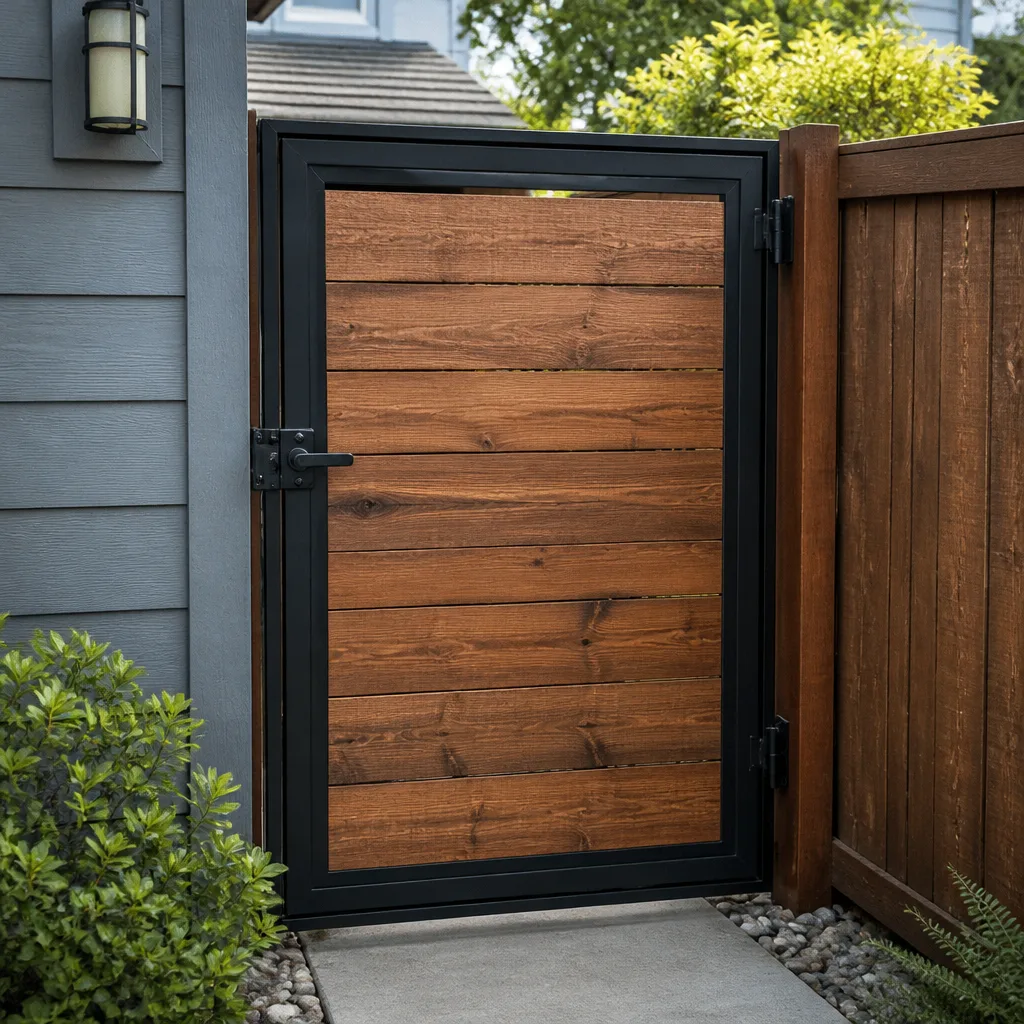 Wood & steel frame
 Farm & ranch
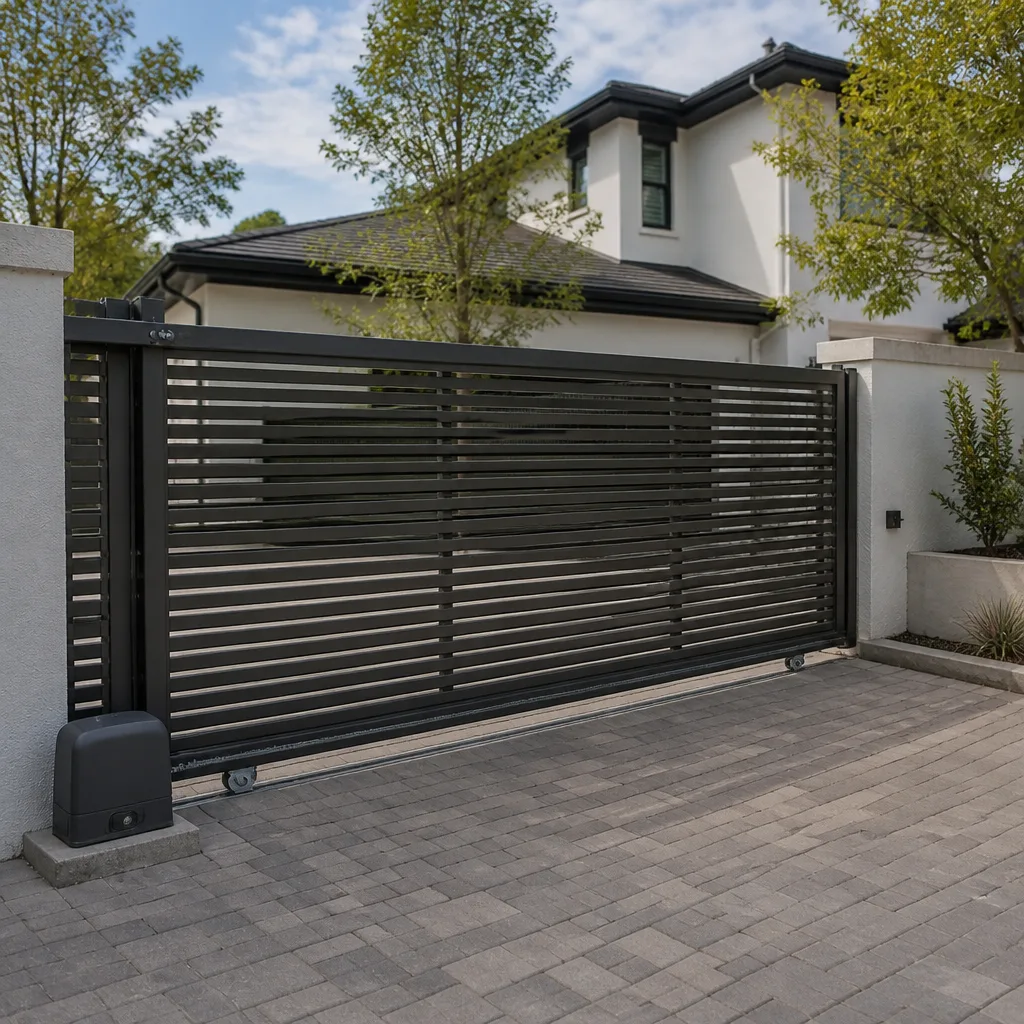 Sliding driveway gates
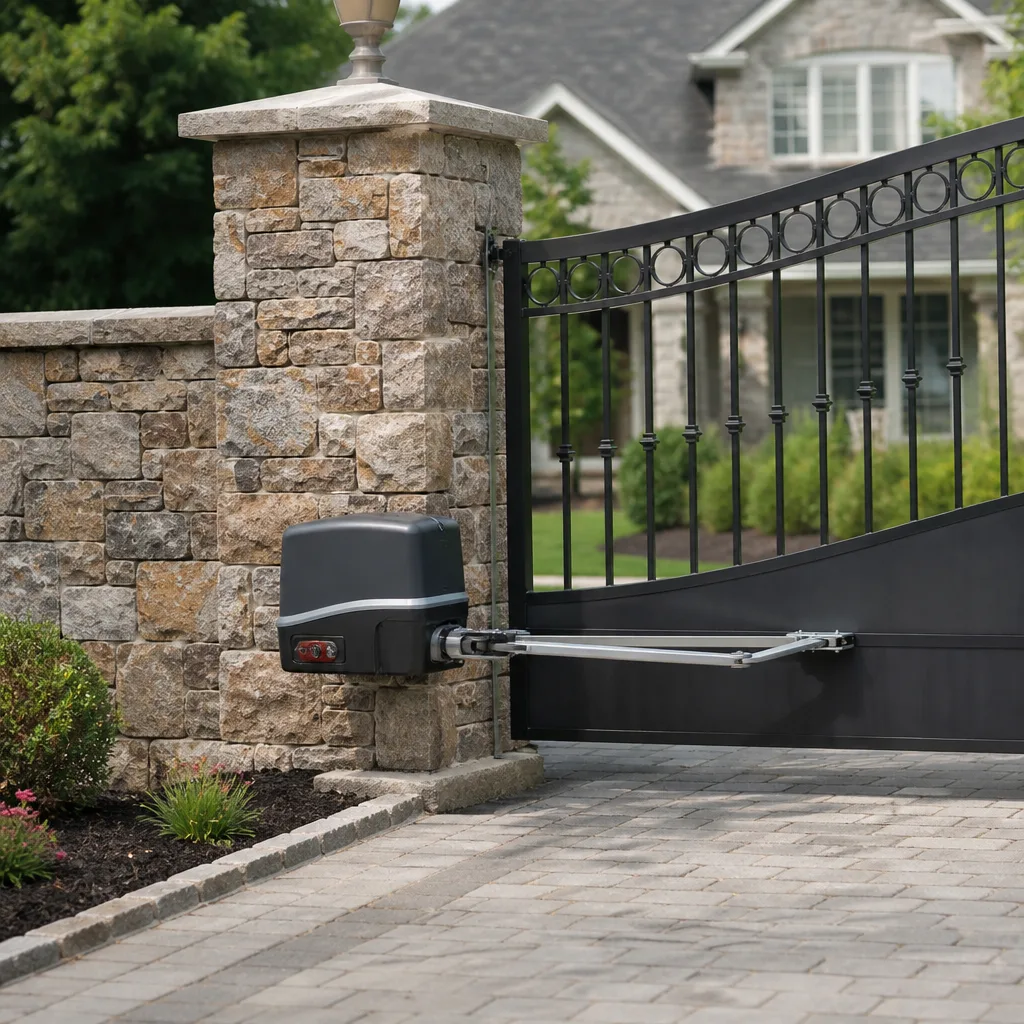 LiftMaster operators
Free on-site gate assessment - hinges, posts, and your LiftMaster or Nice gate operator checked before anything is quoted
The assessment is free and the quote is the invoice.
Get your free estimateGate Repair Emergency Preparedness Guide for Surprise Homes
Most gate emergencies aren’t sudden. They build quietly over weeks, then announce themselves at the worst possible moment: a haboob rolling across the west valley with visibility dropping by the minute, a contractor blocked at the keypad, a family member stuck outside. The single most common mistake we see is treating a gate failure as a phone number to find under pressure. It isn’t. It’s a plan you build on a quiet afternoon so the loud ones don’t rattle you. This guide covers manual releases for every operator type, an emergency access protocol for the people who need your gate, backup power that actually carries a Surprise outage, and the exact information to stage before you need it.
Quick Answer
A gate emergency is a failure that either traps you inside or leaves your property open, and both are solved by preparation, not panic. Before trouble hits in Surprise, learn your operator’s manual release, stage an emergency access protocol for family and responders, and keep a written record of your control board and operator serial numbers. If a gate has already failed, call (877) 657-0401 for a free estimate and same-day repair when the schedule allows.
Styles & brands we work with
- Wrought iron
- Wood & steel frame
- Farm & ranch
- Sliding driveway gates
- LiftMaster operators
Table of Contents
- The Two Kinds of Gate Emergency (and Why They’re Different)
- How to Manually Release a Stuck Gate Without Tools
- The Emergency Access Protocol to Hand Out Before You Need It
- Backup Power for Gate Operators During Surprise Outages
- How to Secure a Gate That Failed in the Open Position
- The Emergency Information to Stage Now
- Haboob Season and Storm-Readiness for Surprise Gates
- Quick Diagnostics: Is It Electrical or Mechanical?
The Two Kinds of Gate Emergency (and Why They’re Different)
A gate has exactly two failure modes that matter, and they demand opposite responses. Failing closed means the gate won’t open and your vehicles are trapped behind it. Failing open means the gate won’t close and your property sits exposed. Neither is worse than the other in the abstract; what makes one an emergency is what’s on the other side of the moment. A stuck-closed gate in a medical situation is a serious problem. A stuck-open gate on a dark residential street in Surprise is a security exposure that gets worse every hour it stays that way.
In our experience, most homeowners prepare for the closed failure and forget the open one entirely. That’s backwards. Failing closed is inconvenient but stops your day; failing open leaves a gap that anything from a stray dog to a car can wander through. A gate’s job is boundary control, and a gate frozen in the open position has stopped doing its job completely.
The first thing to establish with any failed gate is which failure you’re looking at, because it changes what you do next:
- Failed closed: Access is blocked. Your priority is restoring movement, by manual release if you have it, or repair if you don’t.
- Failed open: Access is uncontrolled. Your priority is securing the opening, even temporarily, while a repair is arranged.
- Failed halfway: The gate is stuck mid-travel. Don’t force it. This usually signals a mechanical problem in the track, rollers, or operator arm, and pushing a heavy panel can make it worse.
Once you know which of these you’re facing, everything else in this guide has a place. The rest of it is about moving from “the gate’s broken” to “here’s my next step,” in order.
How to Manually Release a Stuck Gate Without Tools
Nearly every automated gate sold today has a manual release, and the reason most people can’t use it is that nobody ever showed them where it is. The good news is you can find and operate it without tools, in the dark, with a flashlight in your teeth. The slightly less good news is that the release is different for each operator type. Learn the one you have.
Swing-arm operators
Swing-arm operators (common on residential driveways, and a family we see installed across many brands) usually release with a key or a lever built into the top of the arm housing. Turn the key or flip the lever, lift the arm off its mount, and the gate swings free by hand. Store the key on your key ring, not in a drawer you’ll forget. If you can’t find the release, look at the operator housing for a small cylinder lock or a labeled cover plate.
Slide-gate operators
Slide operators typically use a release lever or a manual chain on the motor housing. Some have a keyed release; others have a lever you pull to disengage the drive gear. Once disengaged, the gate slides by hand along its track. Test that it moves freely in both directions; if it binds, the problem is the gate itself, not the operator, and forcing a slide gate off its track is how panels get bent and people get hurt. Call a professional before you muscle it.
Overhead and barrier operators
Overhead operators, common on commercial and HOA entrances, often have a crank or a release chain that lets you raise or lower the arm by hand. Those systems are heavy. Never stand under an overhead arm that’s been released, and never let anyone walk through while you’re manually holding it. This is a two-person job at minimum, and on a genuinely large commercial arm, leave it to trained technicians.
Once you have released the gate, get it to a stable position (fully open or fully closed, not dangling halfway), then secure it so it can’t drift. A released slide gate can roll; a released swing gate can catch the wind. If you’re not sure your release is engaged properly, stop and call (877) 657-0401. A mis-released operator can come back to life and move an arm while someone’s standing in the way.
The Emergency Access Protocol to Hand Out Before You Need It
The people who need to get through your gate on a normal day are the same people who will need to get through it when it fails. So decide in advance who needs access and how they’ll get it, and write it down somewhere other than your phone (which, when the power’s out, may be the one thing you can’t use). This isn’t about keeping secrets; it’s about controlling who has a code and making sure the right people aren’t stuck outside during a failure.
The three-part protocol
- Name the people who need access. Family members, a caregiver, a regular contractor, and emergency services all belong on the list. Each one needs a clear path in that doesn’t depend on the gate operator working.
- Give each person the manual release location and how to use it. A three-sentence description on an index card, or a labeled photo on your phone, is enough. The person who needs it is not going to look it up under pressure.
- Tell emergency services where they can reach you and what to do if the gate won’t open. When you call 911, tell them the gate may not open and describe where the manual release is or where the gate can be physically opened. Their dispatchers deal with this; what they need is you giving them the details.
For contractors and property managers overseeing a gated community in Surprise, the protocol should live in a written document kept at the property, not just in someone’s memory. If the gate fails during a storm, the person on site needs the release instructions and your after-hours line without calling around. We see HOAs that get this right treat gate access as part of their overall emergency plan, right alongside fire and water shutoffs, and that’s exactly the right level of attention.
If your gate is a slide or swing operator from BFT, Linear, Viking or Ghost Controls, the release method is printed in the manual for that model. Keep the manual with your emergency information. If it’s been lost, that’s a solvable problem: the model number on the housing tells a technician what release it uses.
Backup Power for Gate Operators During Surprise Outages
Every automated gate in Surprise runs on its operator, and the operator runs on your property’s power. When that power goes, the gate stops where it stands. Most residential operators ship without a battery backup, so unless someone added one, your gate is only as reliable as your utility feed. That’s the fact most homeowners don’t learn until the first long outage.
What battery backup actually does
A backup battery on a gate operator doesn’t turn it into an unlimited-power machine. It holds enough charge to move the gate a limited number of cycles during an outage, usually enough to open the gate once for departure and close it once on return, depending on the size of the battery and the gate. That’s the whole point: it gets you out and back in. It won’t keep the gate cycling all night.
What capacity you actually need
Size the backup to your real need, not to a spec sheet’s numbers. Ask:
- How many cars need to get through during a typical outage? If it’s two vehicles, a modest battery is enough.
- How long do outages last here? Short, frequent outages and rare long ones call for different priorities.
- What does the operator draw? Slide and swing operators differ, and a commercial overhead arm draws more.
- Does the operator have a built-in battery bay or require an external unit? Some brands ship with the bay and no battery.
If your operator didn’t come with a backup and you want one, that’s a scheduled installation, not an emergency. It’s a free measure and a written price, not a same-day job, and we’re glad to quote it before the next storm comes through. Most brands including the ones we work with now support some form of factory battery option, and we can tell you what fits what you have. In the meantime, know that a manual release is your outage plan; a battery only buys cycles.
How to Secure a Gate That Failed in the Open Position
A gate stuck open needs two things at once: the appearance of access control and actual access control. They’re not always the same, and the temporary measures that matter are the ones that keep the opening physically closed, not just visually. Whatever you do, don’t do anything that damages the gate or your property, and never tie a heavy slide gate to something that will bend when the wind pushes it.
Practical options for a temporarily secure opening
- Close the gate manually and pin it. If the operator is disengaged, the gate will usually close by hand. Once closed, use a proper locking pin or a chock at the base of the gate so it can’t roll or swing open. This is the option that keeps your property actually secured.
- Use a temporary barricade across the opening. For wide slide-gate openings, a movable barrier parked across the gap (with the gate closed behind it) stops casual vehicles and marks the opening as closed while you wait.
- Physically block the track or hinge. A wheel chock against a slide gate’s track, or a wedge at a swing gate’s hinge, will stop it moving. This is for short waits only, and don’t leave it in place for days.
- Notify anyone with automatic access. If your household or HOA gate is stuck open, tell the people who use it not to drive through on the assumption the gate is working. A gate stuck open is also a gate that can come down on a vehicle if the operator wakes up unexpectedly.
None of these is a substitute for a repair, and none of them is a long-term solution. The purpose is to buy a few hours of physical security while a proper repair is on the calendar. In our experience, the temporary measures that hold up are the ones that use the gate’s own mechanism (closing it and locking it) rather than fighting it. If the gate won’t close by hand at all, that’s a mechanical problem and the call goes out before the gate can be secured by hand. That’s what we’re here for: gate repair is our most common callout, and a stuck-open gate is a classic.
The Emergency Information to Stage Now
When your gate fails, the first thing you’ll want is everything you don’t have in your hand. The control board model number, the operator serial number, the brand, the approximate gate width and weight, and the after-hours line for the gate company are all things you can gather today in about ten minutes and should never have to hunt for again. Write them down and keep the record somewhere that doesn’t depend on power or a phone signal.
Your gate emergency file
- Operator brand and model. LiftMaster, FAAC, BFT, Linear, Viking, Ghost Controls, DoorKing, Elite and Mighty Mule all have different diagnostics, and knowing which you have shortens the call.
- Operator serial number. It’s stamped on the operator housing and lets a technician confirm the exact unit, matching parts and backward-compatible options.
- Control board model or revision. Often printed on the board itself behind the operator cover. If you can’t reach it safely, skip it; the technician will find it.
- Gate dimensions. Measure the panel width and estimate the weight if you can. A 16-foot slide gate and a 6-foot swing gate are different jobs.
- Your installer’s or gate company’s after-hours line. The number for whoever you’ll call. Put ours in: (877) 657-0401. We answer 24/7 and fast dispatch runs from 7am to 7pm, Sunday through Friday.
- Manual release location and method. One line: where the release is and how it works for your operator type.
- The access protocol. Who to call and what to tell them. That’s the document from the section above.
Keep one copy inside the house and one with the people who need it. About half the calls we take come from people standing at their gate without any of this, and the call takes twice as long as it needs to. The line at electric gate repair moves a lot faster when the caller can tell us the brand and the symptom.
Haboob Season and Storm-Readiness for Surprise Gates
The signature weather event in this part of the state is the haboob: a dust storm that rolls in from the west with little warning, drops visibility to almost nothing, and then moves on. A gate operator that’s already marginal (a weak battery, a strained motor, a control board giving intermittent faults) doesn’t fail in fair weather. It fails when the dust, wind and sudden power flex hit at once. That’s the pattern, and it’s an old one: the storm is when Surprise gate problems announce themselves.
Storm-readiness is mostly about noticing what the quiet season hides. Walk your gate before the season, not during a storm:
- Does the gate move freely by hand when the operator is released? A gate that binds when released has a mechanical issue the motor is currently masking.
- Do the sensors at the base of the gate respond when something crosses them? Dust and grit work into the sensor housings and interrupt the beam.
- Does the gate stay on its track or hinges cleanly through its full travel, or is it tilting slightly at the end of the run? A track out of alignment becomes a stuck gate at the worst possible time.
- Does the operator’s warning light or chime still work? It’s an early indicator of the control board’s health.
- Are the gate’s mounting posts solid? Wind load and heavy panels go after posts that were set too shallow, and a gate panel that shifts on its post is a future failure.
We recommend treating this as a one-time walkthrough once a year, not a maintenance plan. There’s no subscription or contract in this. It’s a visit, a look at the gate, and a written price if something needs repair. If you get a haboob warning and your gate isn’t already in good shape, close it, disengage the operator, and get it serviced when the dust clears. And if a gate fails on a Saturday, we’re closed that day; call anyway, and we’ll book you for Sunday. That’s the simplest answer to a storm-related failure. Same-day work is possible when the schedule allows, and the phone line above is always answered.
Quick Diagnostics: Is It Electrical or Mechanical?
The first question before calling anyone is whether your gate has lost its power or its ability to move. The two look similar from the driver’s seat and are solved in completely different ways. Here’s the short version, from the things a homeowner can safely check:
Electrical or control issues
- Operator completely silent. No movement, no light, no click. Often a tripped circuit breaker or a dead battery. Check the breaker first.
- Gate moves partway and stops. A classic control-board or limit-switch symptom. Don’t keep power-cycling it; the board is telling you something.
- Gate reverses on contact. Sensor or safety edge issue. Look for debris in the sensor path before assuming the sensor is faulty.
- Keypad or remote works intermittently. Often a receiver or antenna issue on the operator, sometimes just a weak remote battery.
Mechanical issues
- Operator hums but the gate doesn’t move. Something is bound. The gate is resisting the motor, and running the motor against a bound gate can burn it out.
- Gate grinds or scrapes along the track. Roller, track, or alignment problem.
- Gate sags on its hinge side. Hinge post or panel issue. Wind and weight are the usual causes.
- Gate panel off its track on a slide gate. This is a danger. Stop using the operator entirely and call.
Electrical and mechanical problems often share symptoms, and misdiagnosing one as the other is how a repair turns into a replacement. Our technicians have up to 13 years of experience and work on whatever gate you have, from a LiftMaster residential swing arm to a DoorKing commercial entrance. Brand-agnostic means we diagnose the actual fault instead of assuming the most common fix for one manufacturer. If you’re not sure which category you’re in, call and describe the symptom. We’d rather save you a wasted trip than guess over the phone.
One note on diagnostics for the do-it-yourselfer: control boards and power wiring inside the operator carry live mains voltage, and the battery terminals on a backup system can deliver a shock even when the gate is “off.” A professional with the right meter and the right training is the safe way to open that housing. We don’t recommend opening the control box yourself, whatever the symptom.
Common Mistakes to Avoid
- Leaving the manual release key in a kitchen drawer. When the gate fails during a Surprise haboob and you’re twenty feet from the operator with dust in your eyes, a key in a drawer is a key you don’t have. Put it on your key ring.
- Forcing a halfway-stuck gate. A gate frozen mid-travel is usually bound on its track or arm. Pushing it by hand can bend a panel that was only a roller away from a cheap fix. Stop, disconnect the operator, and call.
- Assuming your operator has a backup battery. Many don’t. Some ship with a battery bay and no battery. Buyers tell themselves the battery came with it, and the first long outage tells them otherwise.
- Tying a slide gate open with rope or wire. Wind and weight will find the weak point, and a slide gate that’s been improv-secured can come off its track in the first gust. Use the gate’s own lock or a proper pin.
- Not telling emergency services the gate may not open. Dispatchers deal with locked and failed gates, but only if you tell them. Mention it when you call; it’s part of the access protocol.
- Storing the gate’s model and serial numbers only in your phone. Phones die, lose signal, and get left in the car. A written card in the house is the reliable record.
- Skipping the annual walkthrough. The list of storm-readiness checks above is ten minutes on a quiet Sunday. Skipping it means discovering a marginal motor during a storm instead of before one.
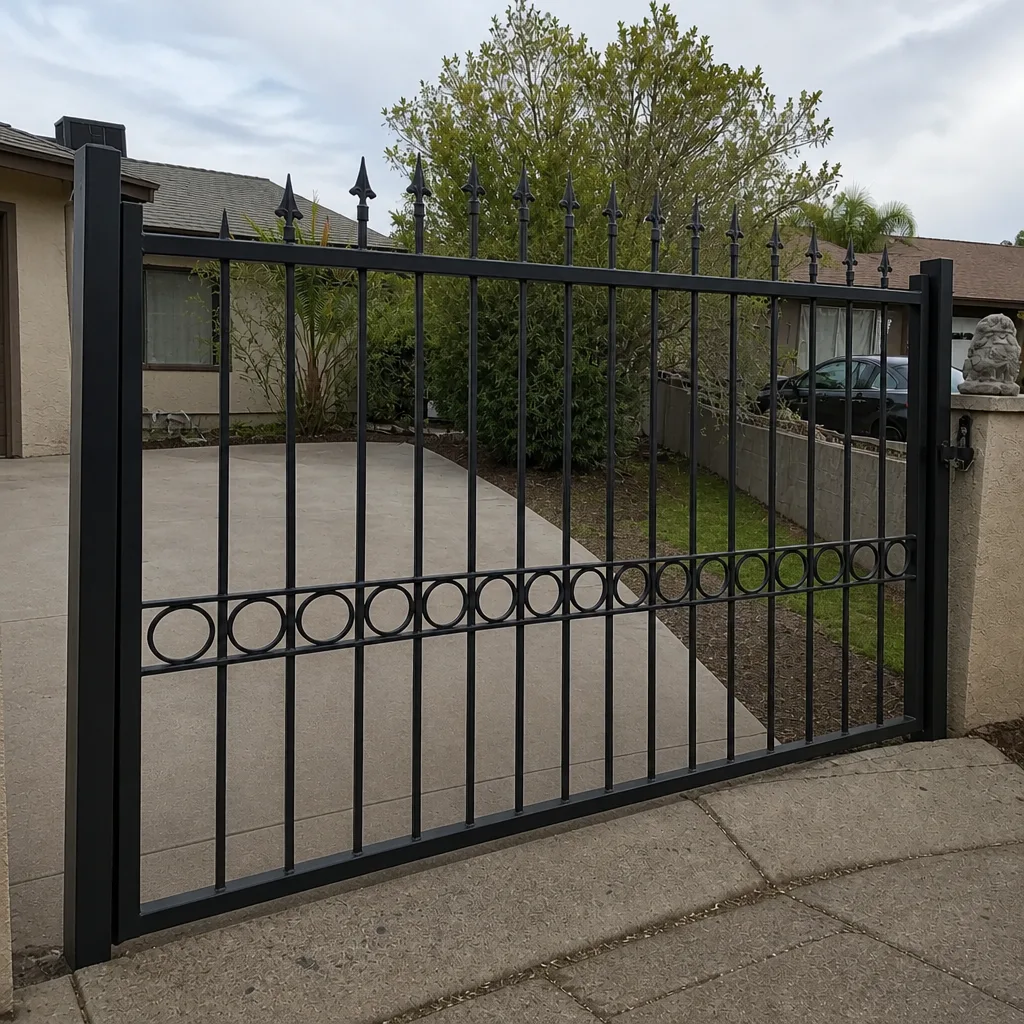
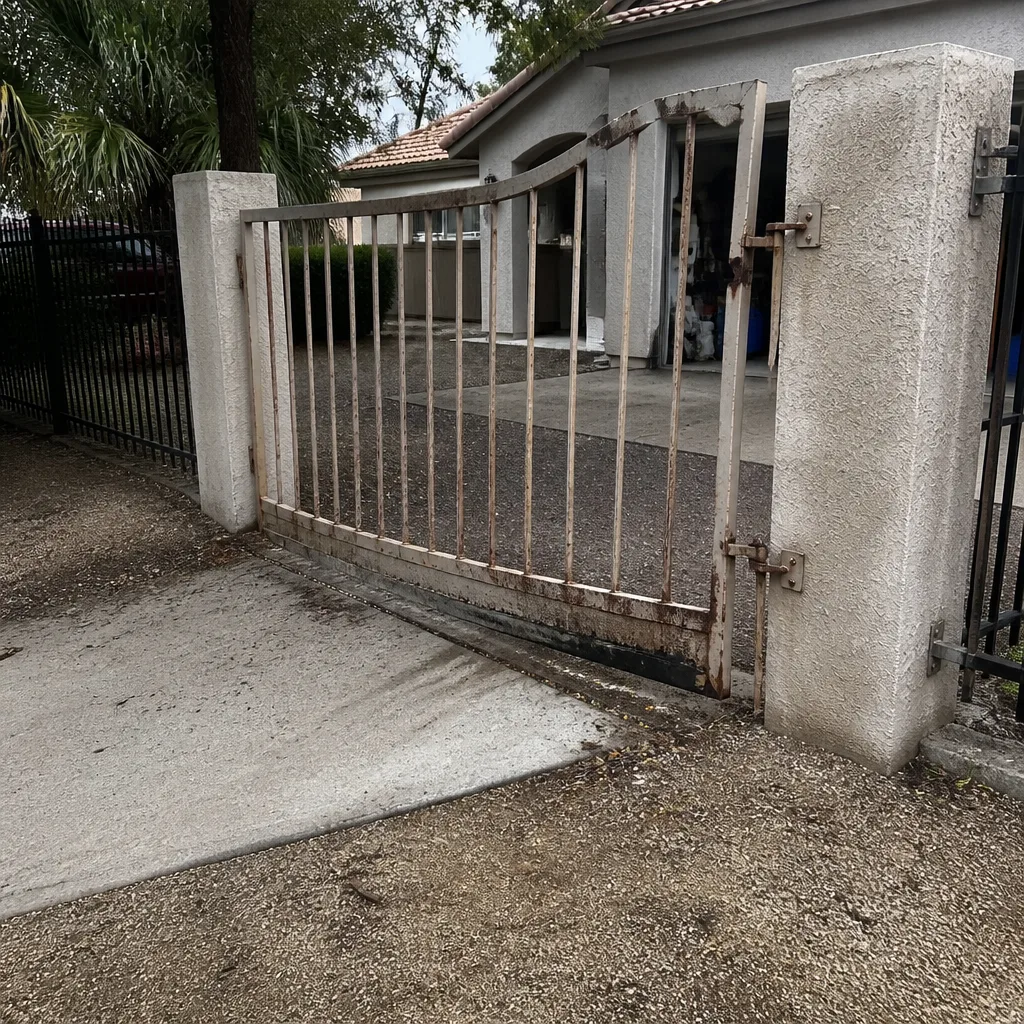
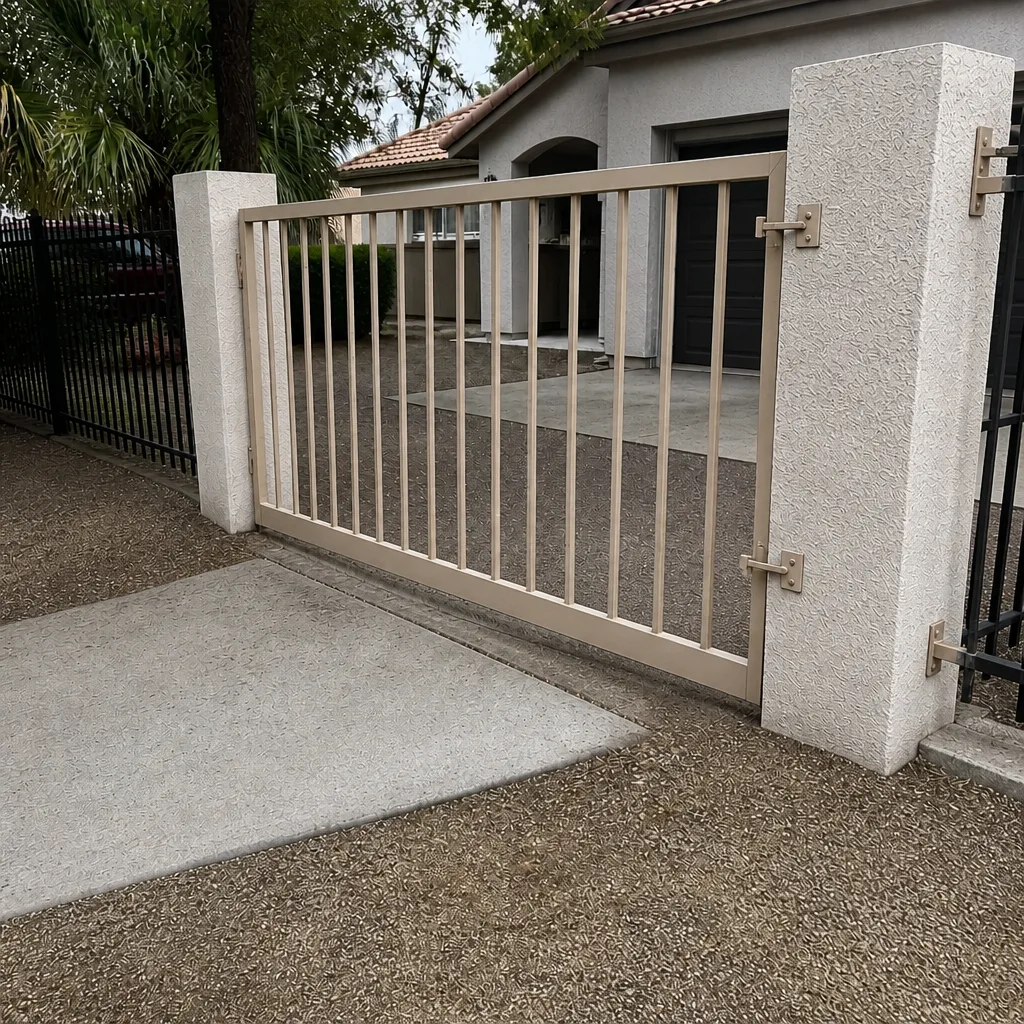
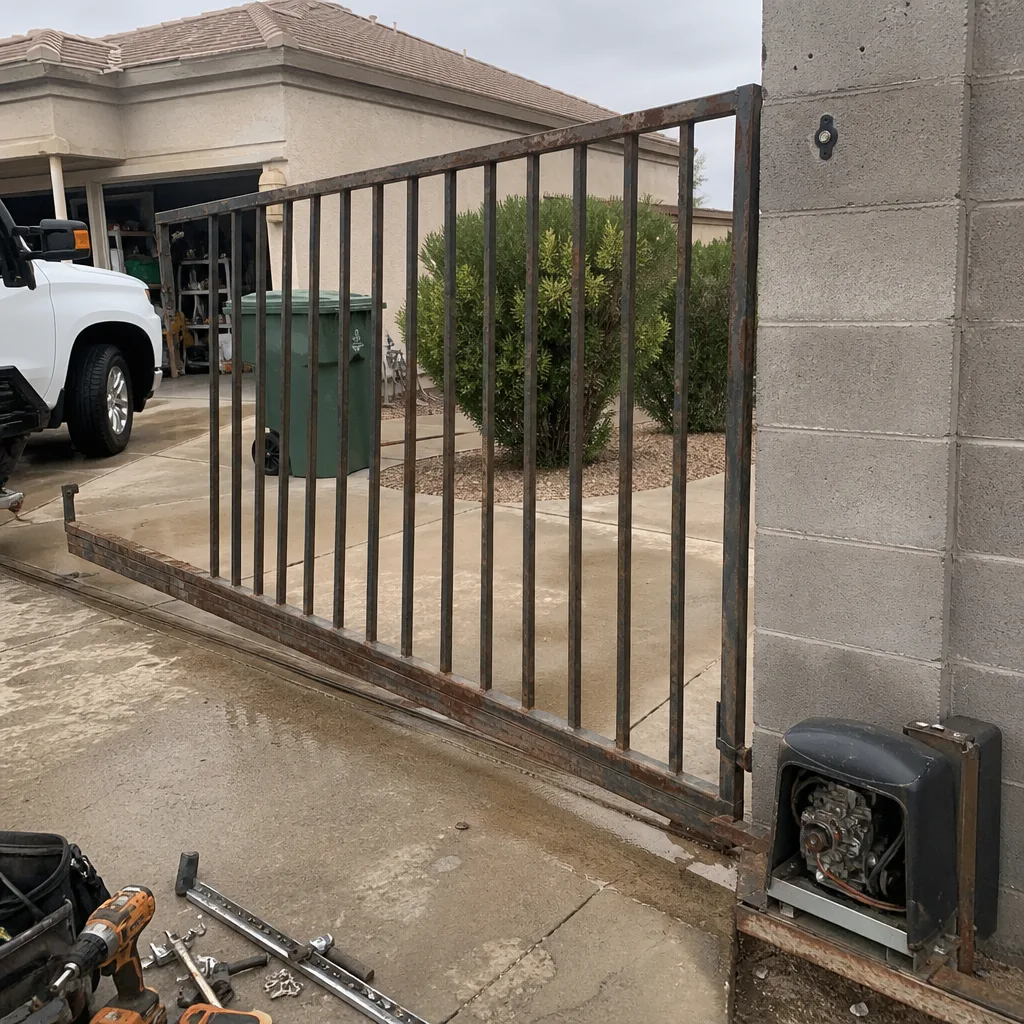
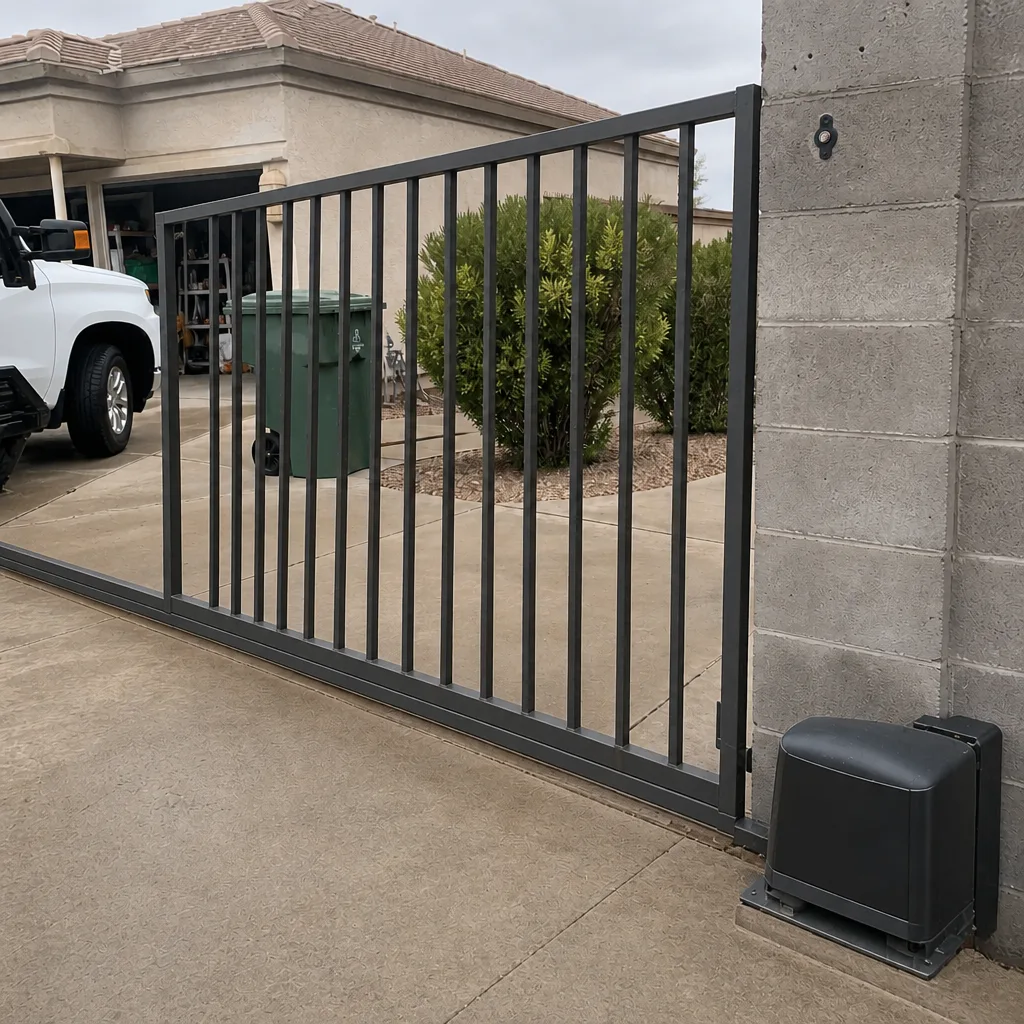
See the difference
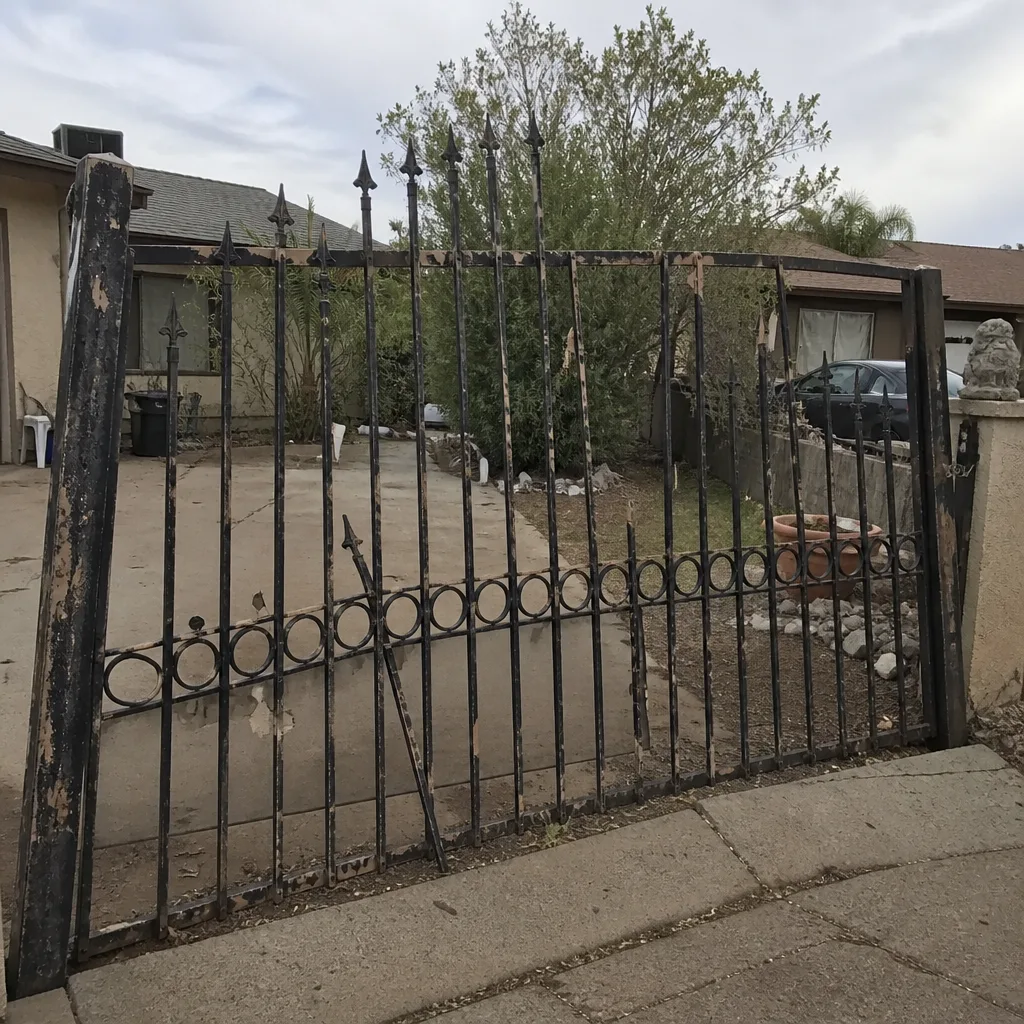 Before
 After
 Before
 After
 Before
 After
When to Call a Professional
Call a professional the moment a gate stops responding to its operator, fails to close fully, moves partway and stops, or comes off its track. Call immediately if a gate has failed in the open position and cannot be closed by hand, or if it’s a heavy commercial or HOA entrance where the panels and overhead arms need more than one trained person. Any symptom of a control board fault, a live electrical smell, or a motor that hums without moving the gate is a stop-use call. A release that won’t engage, a gate that won’t move even when released, and a panel that sags on its post all warrant a technician. We offer free estimates in Surprise, and a same-day appointment when the schedule allows; a call outside dispatch hours is booked into the next opening, Sunday through Friday, 7am to 7pm. Call (877) 657-0401 and describe the symptom. A repair visit is priced per job by the written estimate, agreed before any work starts. The price we quote is the price you see.
Frequently Asked Questions
Use the operator’s manual release, which every automated gate has and most homeowners never learn. For a swing-arm operator, release the housing with its key or lever and lift the arm off its mount. For a slide operator, find the release lever or manual chain on the motor housing and disengage the drive gear, then slide the gate by hand. If the gate won’t move freely after release, it’s a mechanical issue, not a power one, and it’s time to call. Call (877) 657-0401 for a free estimate if you’re not sure how your release works.
A gate stuck open is usually a failed sensor, a control board fault, or a mechanical bind that the operator can’t push through, and yes, it’s an emergency because the property is exposed. The usual Surprise triggers are haboob dust working into the sensor path, an outage that left the operator without a charged backup, or a gate that was already binding and finally stopped. Close the gate by hand if you can and lock it, then call (877) 657-0401. We answer 24/7 and can dispatch from 7am to 7pm, Sunday through Friday.
No, and that surprises a lot of homeowners. Many residential operators in Surprise ship without one, and some ship with a battery bay that’s empty until someone adds a battery. A backup buys you a limited number of cycles during an outage, usually enough to get one car out and back in, not enough to keep cycling all night. If your gate failed during the last outage, a backup battery is a scheduled installation, not an emergency repair. Call (877) 657-0401 for a free measure and a written price.
Have the operator brand, the operator serial number, the approximate gate width and weight, and a description of the symptom. If you know the control board model, even better. LiftMaster, FAAC, BFT, Linear, Viking, Ghost Controls, DoorKing, Elite and Mighty Mule all diagnose differently, and knowing your brand shortens the call. If you can’t get any of that, describe what the gate does and doesn’t do; that’s often enough. Call (877) 657-0401 and we’ll take it from there.
The best option is to close the gate by hand after releasing the operator, then pin or lock it so it can’t move. If the gate won’t close, a wheel chock or wedge against the track or hinge will hold it for a few hours, and a movable barrier across the opening keeps vehicles from driving through. Don’t use rope or wire, which can slip or fail in the wind. This is a stopgap only; a gate failing open needs a repair, and a same-day visit is possible when the schedule allows. Call (877) 657-0401 for an exact quote; estimates are free.
Yes, when the schedule allows and the repair doesn’t require parts we have to order. Many stuck gates, sensor failures and control faults are resolved on the first visit. Installation and backup power work are measured, ordered and scheduled, not same-day. A call outside dispatch hours is booked into the next opening, Sunday through Friday, 7am to 7pm. Call (877) 657-0401 to find out what your gate needs.
The Bottom Line
A gate emergency is a failure of preparation more than a failure of machinery. The gate operator that fails in a haboob was usually already telling you it was marginal. So prepare for both failure modes: stashing the manual release on your key ring, staging the model and serial numbers in writing, teaching the release to the people who need in, and knowing which way to act when a gate fails closed versus open. That’s the whole system. If you’ve done those four things, a stuck gate in Surprise is an inconvenience with a known next step, not a crisis. If you haven’t, or if your gate is already showing symptoms, we’re specialists: Surprise homeowners and property managers can reach a gate-only team that works on whatever brand they have, diagnoses the actual problem, and quotes the price before the work starts. Call (877) 657-0401 for a free estimate. We answer 24/7, and fast dispatch runs from 7am to 7pm, Sunday through Friday. For the wider picture of what we handle, start at Gate Repair Surprise.
Written by the team at Gate Repair Surprise.