
Last updated November 15, 2026
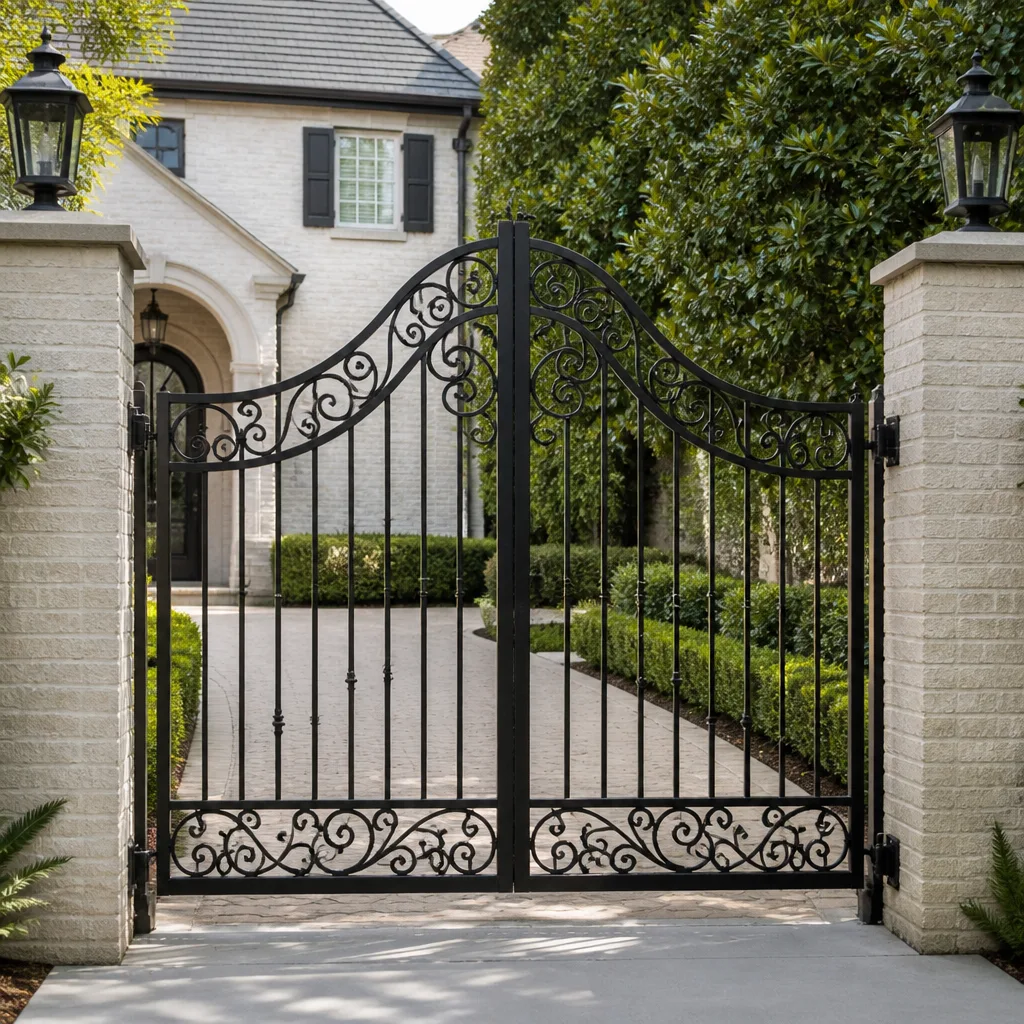 Wrought iron
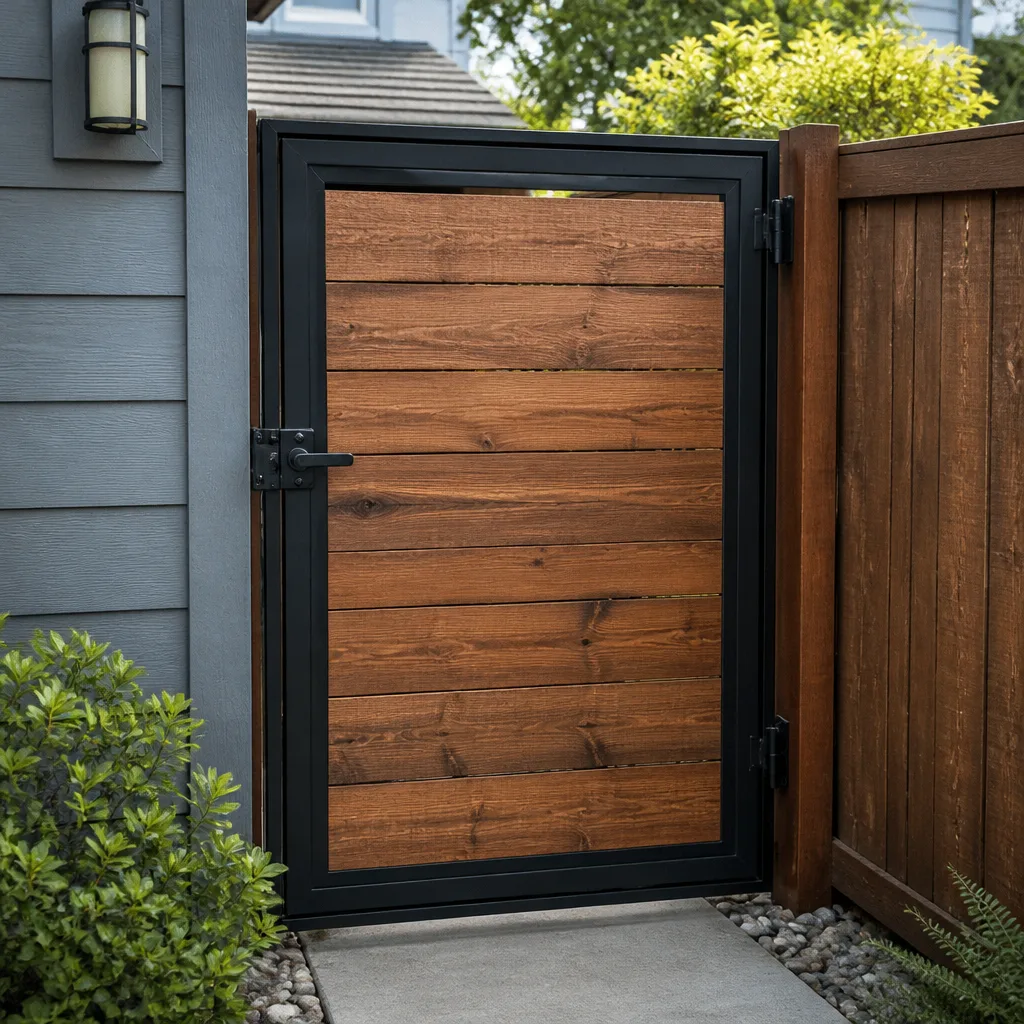 Wood & steel frame
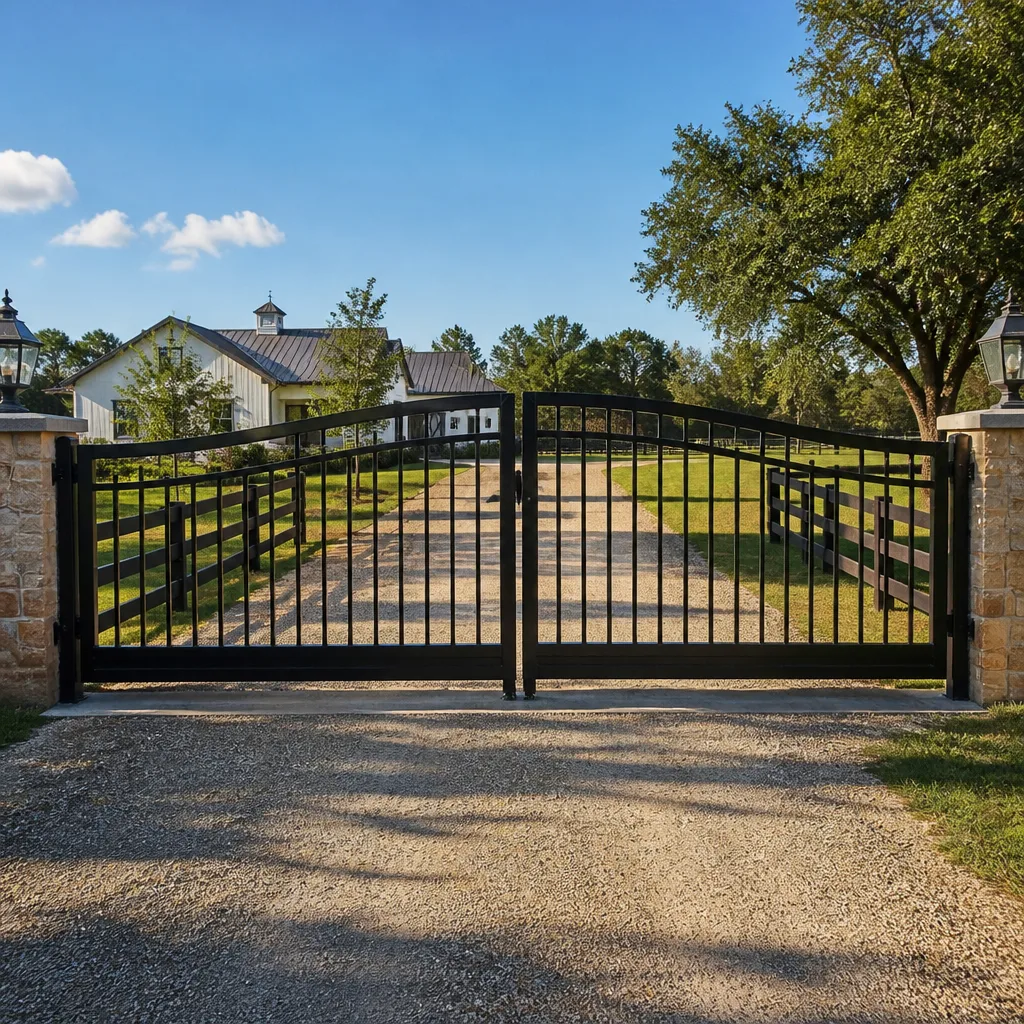 Farm & ranch
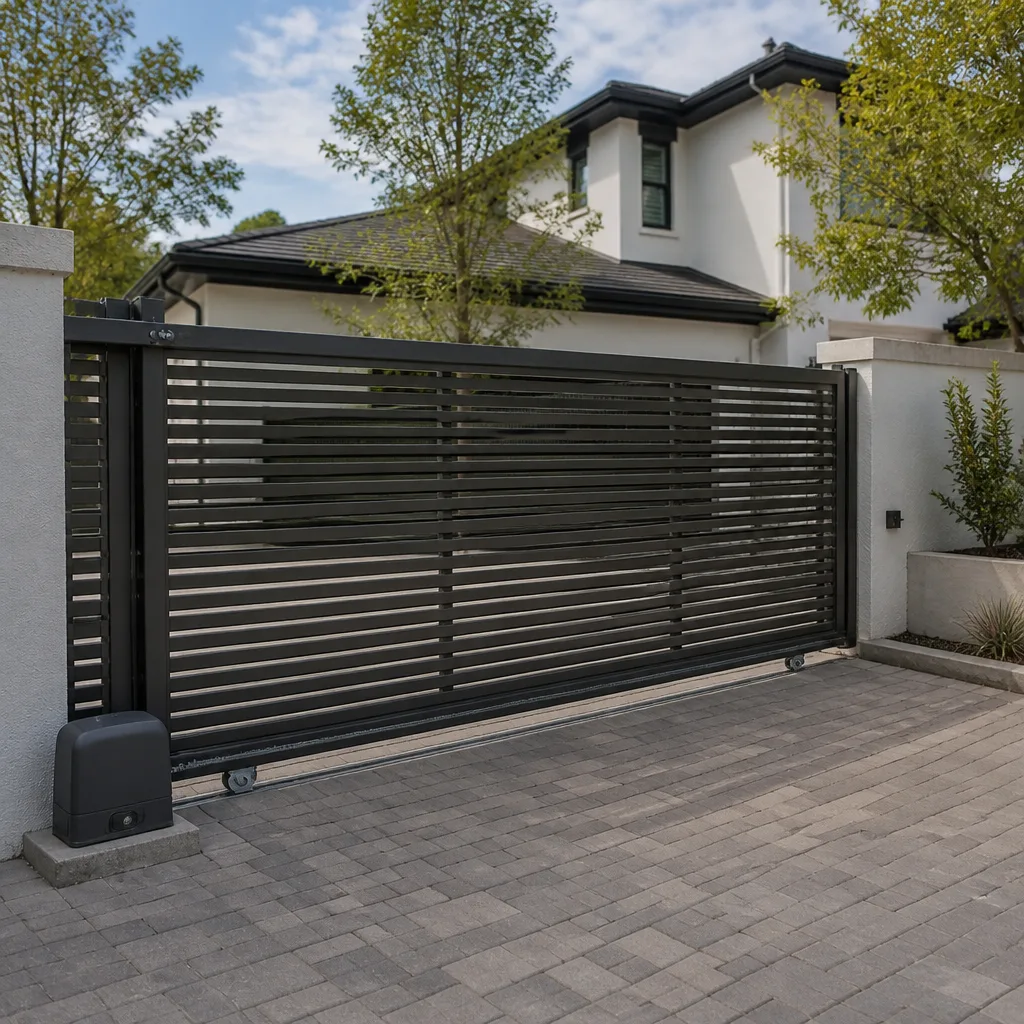 Sliding driveway gates
 LiftMaster operators
Free on-site gate assessment - hinges, posts, and your LiftMaster or Nice gate operator checked before anything is quoted
The assessment is free and the quote is the invoice.
Get your free estimateGate Repair Troubleshooting in Surprise: Common Problems and How to Fix Them
The gate that “just stopped working” almost never stopped for one reason. When a driveway gate refuses to move, the motor gets blamed first, and the motor is often the last thing that failed. A corroded limit switch, a photoeye knocked out of line by an August afternoon, a control board that rebooted into the wrong mode after a brownout: these produce the same silent, unhelpful symptom as a dead operator. Replace the motor when the real culprit was a sensor, and the new motor inherits the old problem. This guide walks you through how a gate specialist reads symptoms in Surprise, Arizona, which failures are safe to check yourself, and where the live wiring starts.
Quick Answer
Gate problems in Surprise usually trace to one of five root causes: obstruction sensors out of alignment, limit switches worn or corroded, control board or wiring faults, operator motor failure, or physical damage to the gate panel and track. Which one you have is determined by how the gate fails, not by how old it is. A gate that won’t move at all, one that reverses mid-travel, and one that opens but won’t close each point to a different subsystem. Read the symptom first, then match it to the cause.
Styles & brands we work with
- Wrought iron
- Wood & steel frame
- Farm & ranch
- Sliding driveway gates
- LiftMaster operators
Table of Contents
- How Do You Tell Mechanical Failure From Electrical Failure?
- Three Symptoms, Three Different Subsystems
- Why Surprise Heat Breaks Photoeyes and Loop Detectors
- What’s Safe to Reset Yourself (and What Isn’t)
- Brand Quirks: Beep Codes, Error Flashes, and Where to Look
- What Does Gate Repair Cost in Surprise?
- How to Keep a Gate Working Through a Surprise Summer
How Do You Tell Mechanical Failure From Electrical Failure?
You separate the two by listening and by hand, before anyone touches a meter. Mechanical problems announce themselves with friction, grinding, sagging, or a gate that moves stiffly with the operator disconnected. Electrical and control problems go quiet: the gate is smooth and free by hand, but the operator either does nothing, does the wrong thing, or stops without explanation. That single test, done with the power off and the gate in manual release, tells you which half of the system to investigate.
Work through it in this order:
- Power off at the breaker that feeds the operator. Never skip this step.
- Put the operator into manual release. On most slide and swing operators this is a keyed lever or a pull handle on the housing.
- Move the gate by hand through its full travel. A gate that rolls or swings smoothly points to an electrical or control fault. A gate that binds, scrapes, or stops hard points to a mechanical cause: worn rollers, a dropped hinge, a bent track, or debris in the path.
- Look at the gate panel itself. Sagging, racked panels, and posts that have shifted pull the gate out of square and overload the operator. In Surprise, ground movement after a heavy monsoon soak can shift a post enough to bind a slide gate that was fine in June.
- Check for physical obstruction along the track or swing arc: gravel, palm fronds, toys, landscape rock.
If the gate is free by hand, the fault lives in the operator, the sensors, or the wiring between them. If it binds, fix the mechanical cause first. An operator forced against a binding gate will eventually fail, which is how a mechanical problem turns into an electrical one.
Three Symptoms, Three Different Subsystems
How a gate fails is diagnostic. “Won’t open,” “reverses mid-cycle,” and “opens but won’t close” are not variations of the same problem. Each points at a different part of the system, and treating them as one problem is where guesswork gets expensive.
Gate won’t move at all
A gate that sits completely still usually means the operator has no power, has tripped a limit, or has lost its command signal. Check the obvious first: the breaker, any disconnect switch, and whether the operator’s display or LED is lit. If the board shows no life, the fault is upstream in the power feed or the board itself. If the board is alive but the gate ignores every command, look at the receiver, the keypad, and the safety input. Many operators will refuse to move if a safety edge or photoeye reports an obstruction, and the gate simply sits there looking dead.
Gate reverses mid-cycle
A gate that starts, travels partway, and then reverses is telling you a safety input triggered. The operator is doing exactly what it should. On slide gates, the photoeye beam is the usual suspect: misalignment, a dirty lens, or sun glare across the lens. On swing gates, a safety edge on the leading edge of the panel can trip, or the operator can hit its travel limit early because the limit switch has drifted. A board that loses its position memory can also reverse because it thinks it has hit resistance.
Gate opens but won’t close
This one is almost always a safety circuit holding the gate open. The operator is designed to fail open, so anything on the safety loop, a photoeye, a loop detector, a safety edge, keeps the gate parked. Loop detectors in particular are sensitive to a vehicle sitting on the loop, and a failing detector can latch as if a car were always present. Check for a car, a bicycle, or a parked trailer on the loop, then look at the detector’s indicator light.
Why Surprise Heat Breaks Photoeyes and Loop Detectors
Photoeyes and loop detectors are the two components most sensitive to desert heat, and both fail in ways that look like something else. A photoeye is a paired transmitter and receiver hanging on either side of the driveway. The housing expands and contracts through the day, and the mounting brackets, often the weakest part of the installation, shift a fraction of an inch. That’s enough to break the beam. The gate then reverses, refuses to close, or stops partway, and the operator gets blamed.
Loop detectors, the inductive coils buried in the driveway that sense a waiting vehicle, are potted electronics living in a box near the gate. That box can sit in direct sun at temperatures well above ambient. Heat degrades the electronics inside, and the detector starts to false-trigger, holding the gate open or refusing to accept a command. In cooler climates these components last years longer because they never see the same thermal load. In Surprise, we treat photoeye alignment and loop sensitivity as seasonal checks, not one-time installations.
Signs the heat is winning:
- The gate works in the morning and fails in the afternoon.
- Problems start after a week of triple-digit highs.
- A photoeye LED flickers or reads weak in direct sun.
- The loop detector holds the gate open when nothing is on the driveway.
- Reversals cluster on the side of the driveway facing west.
When a gate misbehaves only in the heat of the day, suspect the sensors before the motor. A motor that runs fine in the morning is not the problem at 3pm. Our electric gate repair technicians diagnose sensor and detector faults with the gate under load, because a system that passes a cool-morning test can still fail on a hot afternoon.
What’s Safe to Reset Yourself (and What Isn’t)
Some gate problems are genuinely safe to check on your own. Others involve live 120-volt components and should never be opened by a homeowner. The line between them is clear: anything that requires opening an operator housing, touching a control board, or working near the power feed belongs to a technician. Everything else you can inspect with your eyes and a rag.
Safe to check yourself
- Wipe the photoeye lenses. Dust and grit coat the lens in Surprise, and a clean lens fixes more “phantom” reversal calls than any part.
- Look for an obstruction. A rock, a toy, a palm frond, or a trash can in the swing arc will stop the gate, and clearing it solves the problem.
- Confirm the breaker. Check the breaker that feeds the operator and any disconnect switch. Reset a tripped breaker once. If it trips again, stop and call.
- Check that a car isn’t parked on the loop. A vehicle, bicycle, or trailer sitting on the loop detector will hold the gate open by design.
- Engage manual release only with the power off. Use it to move the gate by hand and confirm it’s free. This is a diagnostic step, not a fix.
Never DIY
- Opening the operator housing to inspect the control board, capacitors, or wiring terminals.
- Touching the power feed or any 120-volt connection at the operator or the gate post.
- Adjusting limit switches on an energized operator, which can send the gate into an unexpected travel.
- Working on a heavy gate panel that could fall or swing unexpectedly. A gate panel can weigh hundreds of pounds and crush a hand or worse.
- Chasing a slide gate that has jumped its track. A gate that comes off the track is a falling hazard, not a DIY repair.
If the gate is free by hand but the operator does nothing, or if you see a burnt smell, scorch marks, or a tripped breaker that won’t stay reset, stop. Those are signs of a live electrical fault, and a trained technician should be the one to open the housing.
Brand Quirks: Beep Codes, Error Flashes, and Where to Look
Every gate brand talks to you differently, and reading the wrong manual wastes hours. A LiftMaster operator that beeps is often signaling a safety-reverse condition or a low battery in a wireless safety device. A DoorKing unit with a flashing error code is usually reporting a specific input fault, and the flash pattern maps to a table in its manual. Same symptom, two completely different meanings. This is why brand-agnostic diagnosis matters: the technician has to read the specific system in front of them, not assume every operator speaks the same language.
Where to find the right reference:
- Find the model and serial plate on the operator housing. Photograph it before anything else.
- Note the exact behavior: number of beeps, number of flashes, pause between them, and when they occur.
- Look up the brand’s troubleshooting table for that model. Ghost Controls, Mighty Mule, Elite, DoorKing, LiftMaster, FAAC, BFT, Linear, and Viking all publish their own code tables, and the codes are not interchangeable between brands.
- Record what changed before the fault (a power outage, a storm, a new keypad, a vehicle on the loop) and tell the technician. That context narrows the diagnosis fast.
We work on all nine of these brands, so we don’t default to a single manufacturer’s fix. A gate repair in Surprise call starts with reading the actual behavior of your specific operator, not with a guess based on the most common brand on the block.
What Does Gate Repair Cost in Surprise?
Gate repair in Surprise is priced per job by a written estimate, and the cost depends on which subsystem failed. A sensor realignment or a photoeye replacement sits at the low end because it’s a small part and a short visit. A control board replacement or a motor swap sits at the high end because it involves more labor and a more expensive component. What we won’t do is quote a number before we’ve looked at the gate, because the symptom alone doesn’t tell us the cost.
What drives the estimate up or down:
- Which part failed. A photoeye, limit switch, or loop detector is a smaller job than a control board or a motor.
- Brand and model. Some operators use widely available parts; others need a specific replacement that has to be ordered.
- Access. A slide gate on a long driveway, or a swing gate tucked behind landscaping, takes longer to service safely.
- Mechanical vs. electrical. A binding gate that needs a post reset or a track repair costs more than a sensor fix.
- Installation quality. Wiring run badly or a sensor mounted loosely often needs a partial reinstall to stay fixed.
The written estimate is what sets the final price, and we quote and agree on that number before any work starts, so there’s no surprise on the invoice. If you’re weighing a repair against a replacement, we’ll tell you which makes sense for your gate. Nothing about the estimate costs you anything.
How to Keep a Gate Working Through a Surprise Summer
Most heat-related gate failures are preventable with a few habits. The gate that fails in July usually gave you warning signs in May that went unread: a slow reversal, a photoeye that needed a nudge, an afternoon where the gate hesitated. Attention to those small signals is cheaper than a mid-summer breakdown.
- Clear the swing arc and track of gravel, vegetation, and palm debris before the first hot stretch.
- Wipe the photoeye lenses on a schedule through the summer, especially the west-facing unit that takes the afternoon sun.
- Watch for new afternoon-only symptoms. If the gate acts up in the heat, get the sensor alignment checked before the motor gets blamed.
- Keep the gate free by hand. A gate that rolls or swings easily puts less strain on the operator and the sensors.
- Check the loop detector if the gate holds open as if a car were waiting when nothing is on the driveway.
When something does fail, a specialist who works on gates every day can read the symptom and go to the right subsystem fast. That’s the whole point of a single-trade focus. For a deeper look at what we handle, our Surprise page covers the systems and brands we service. We’re gate specialists, not generalists, which means every part and every tool is purpose-built for gate work.
Common Mistakes to Avoid
- Replacing the motor first. The motor is the most expensive component and the least often at fault. A corroded limit switch or an off-aligned photoeye will make a new motor fail the same way.
- Treating all gate failures as the same problem. Won’t open, reverses mid-cycle, and won’t close are three different diagnoses. Assuming one cause for all three sends you to the wrong subsystem.
- Ignoring heat-related timing. In Surprise, a gate that fails only in the afternoon is almost always a sensor or detector problem, not a motor problem. Replacing hardware to fix a heat-expansion issue never works.
- Opening the operator housing yourself. Live 120-volt components, capacitors, and wiring are inside. That’s a technician’s work, not a homeowner’s.
- Forcing a gate that’s off its track. A slide gate that has jumped its track can fall. Stop and call rather than pushing it back onto the track.
- Resetting a breaker that keeps tripping. A breaker that trips twice is reporting a real fault. Reset it once, and if it trips again, leave it and call.
- Using the wrong brand’s troubleshooting table. A LiftMaster beep and a DoorKing flash mean different things. Look up the model, not a generic internet answer.
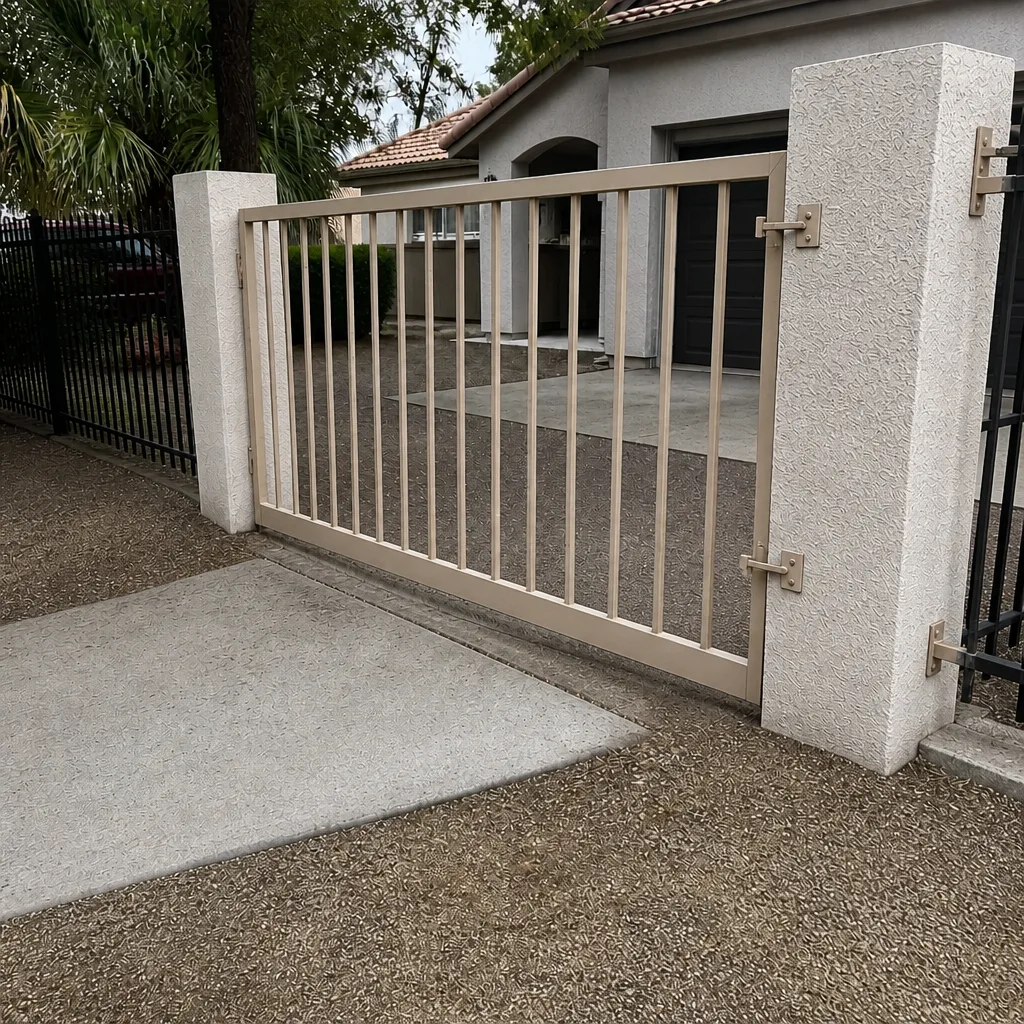
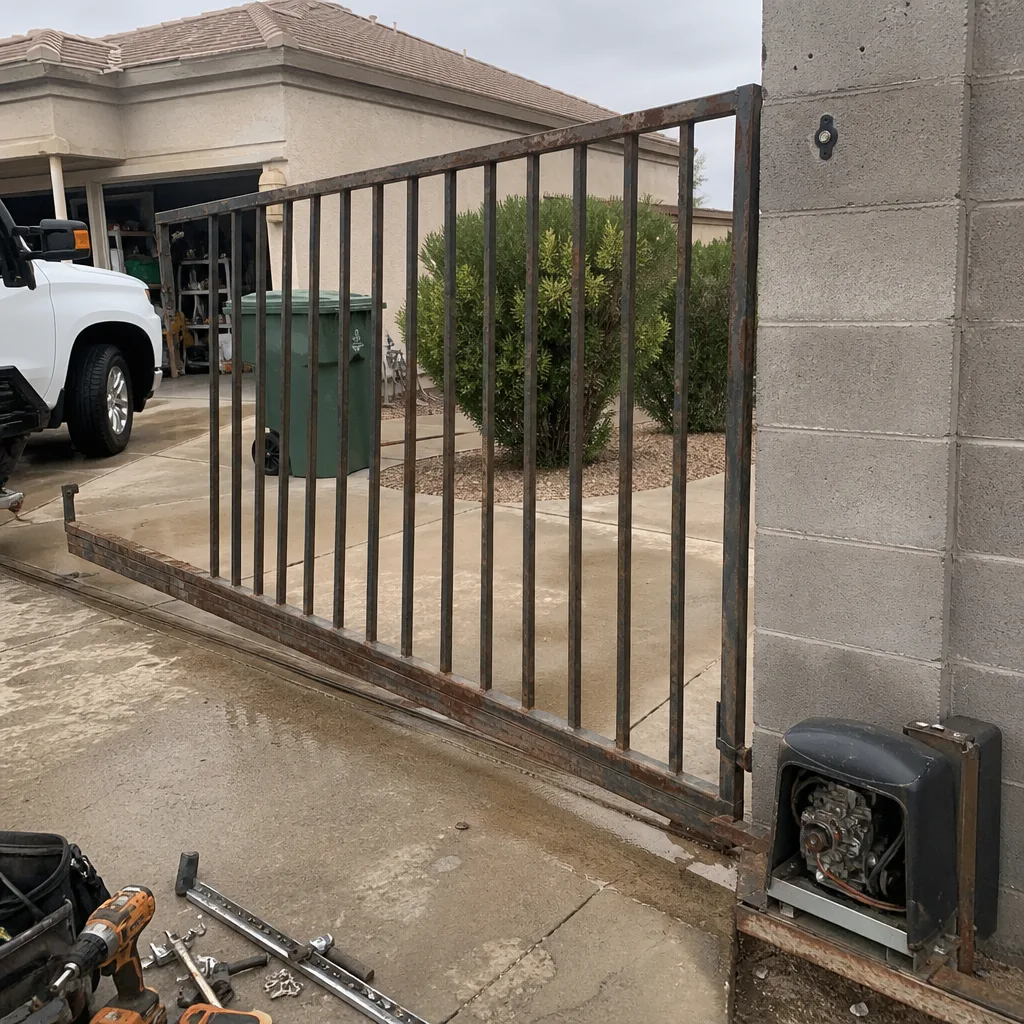
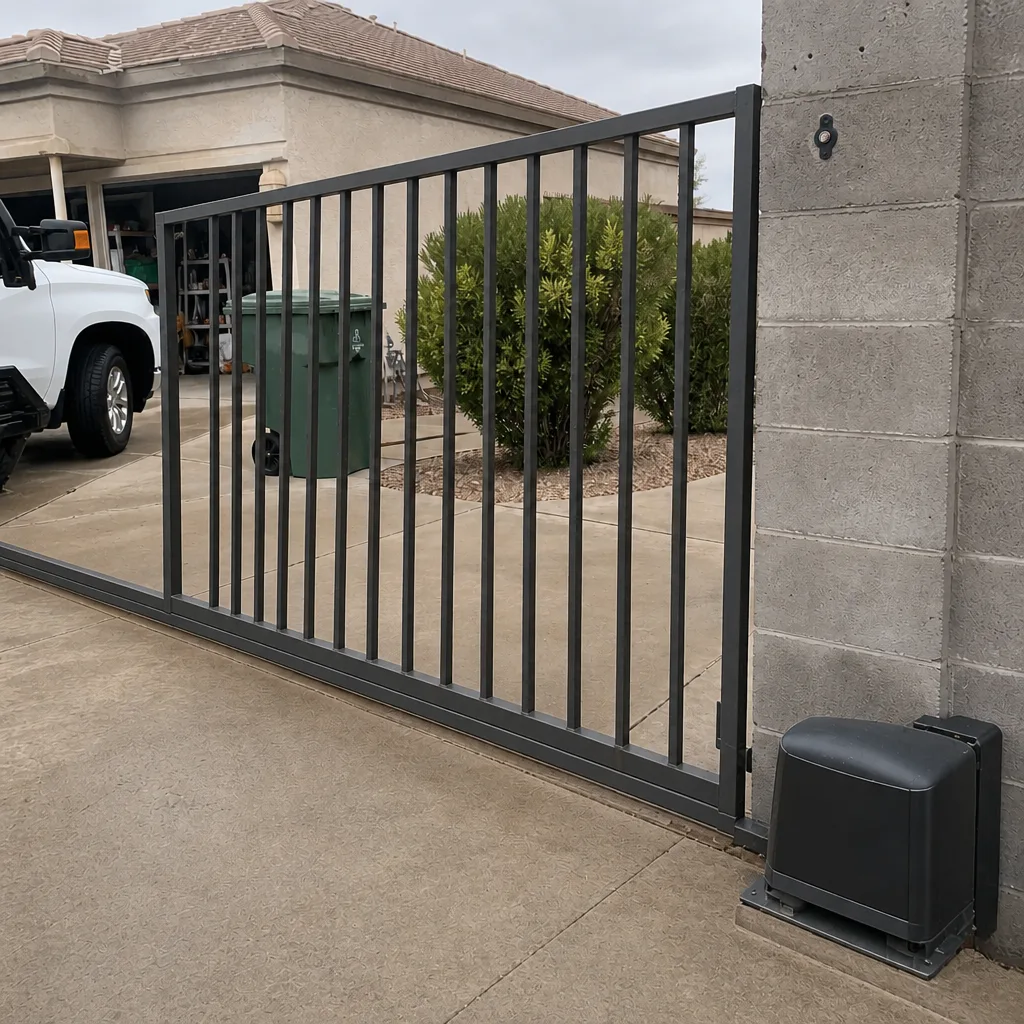
See the difference
 Before
 After
 Before
 After
 Before
 After
When to Call a Professional
Call a professional when the gate is free by hand but the operator does nothing, when the breaker trips and won’t stay reset, when you smell burning or see scorch marks, or when the gate has jumped its track or is sagging off its hinges. Call when the safety edges or sensors keep the gate open and a wipe-down doesn’t fix it. Call when the gate only fails in the heat and you’ve already checked the obvious. Any fault that requires opening the operator housing, touching the power feed, or moving a heavy panel is a job for a trained technician. Gate Repair Surprise offers free estimates in Surprise. Call (877) 657-0401. We answer 24/7. Fast dispatch from 7am to 7pm, Sunday through Friday.
Frequently Asked Questions
Afternoon failures point to heat-sensitive components, usually the photoeye or the loop detector rather than the motor. The housing and mounting brackets shift as they expand in high heat, breaking the photoeye beam or changing loop sensitivity. A system that works in the morning and fails in the afternoon is almost always a sensor-alignment or detector issue. Call (877) 657-0401 for an exact quote, estimates are free.
Yes, and you should. With the power off, engage the manual release and move the gate by hand through its full travel. Wipe the photoeye lenses, clear the track or swing arc of debris, check that nothing is sitting on the loop detector, and confirm the breaker. If the gate is free by hand and the sensors are clean but it still fails, the fault is inside the operator and needs a technician. Call (877) 657-0401 for an exact quote, estimates are free.
They mean different things because each brand uses its own code system. A LiftMaster beep is often a safety-reverse or wireless-safety-device signal, while a DoorKing flash pattern maps to a specific input fault in its manual. The codes are not interchangeable between brands. Find the model plate, note the exact number of beeps or flashes, and look up that brand’s table, or call us and we’ll read it for you. Call (877) 657-0401 for an exact quote, estimates are free.
A gate that opens but won’t close is almost always a safety input holding it open, because operators are designed to fail open. The usual culprits are a misaligned photoeye, a tripped safety edge, or a loop detector latching as if a vehicle were waiting. Check for a car or object on the loop first, then have the sensors checked. Call (877) 657-0401 for an exact quote, estimates are free.
We work on what you have. Our technicians service LiftMaster, FAAC, BFT, Linear, Viking, Ghost Controls, DoorKing, Elite, and Mighty Mule systems, and because we’re brand-agnostic we diagnose the actual fault instead of defaulting to one manufacturer’s fix. Our technicians have up to 13 years of experience. Call (877) 657-0401 for an exact quote, estimates are free.
Gate repair is priced per job by a written estimate, and the cost depends on which part failed. A sensor realignment or photoeye replacement is a smaller job than a control board or motor replacement, and brand, access, and whether the cause is mechanical or electrical all affect the figure. We quote and agree on the price before any work starts. Call (877) 657-0401 for an exact quote, estimates are free.
The Bottom Line
Most gate failures in Surprise trace to one of five root causes, and the symptom tells you which. A gate that won’t move, one that reverses mid-cycle, and one that opens but won’t close each point at a different subsystem. Heat degrades photoeyes and loop detectors here in ways cooler climates don’t see, which is why afternoon-only failures are a sensor problem far more often than a motor problem. Check what’s safe to check, stop at the live wiring, and read the brand’s actual code table before you replace anything. Getting the diagnosis right is what keeps a small fix from becoming a big one.
Ready to get your gate working? Whether it’s a sensor that won’t line up, an operator that won’t respond, or a gate that’s jumped its track, call Gate Repair Surprise at (877) 657-0401 for a free estimate. A specialist can read the symptom, find the real cause, and tell you the price before any work begins. We answer 24/7. Fast dispatch from 7am to 7pm, Sunday through Friday. No job is too small or too large, and one call covers repair and installation.
Written by the team at Gate Repair Surprise.